|
INTRODUCTION |
EWe are in June, but the weather is still changeable, sometimes cool.
After a cold, rainy and long winter, we all need sun and warmer
temperatures, brighter light, and brighter coluors, and why not, we also
need holidays.
For the above mentioned reasons and for some other reasons, we decided to
shift our annual meeting, the national congress, to September.
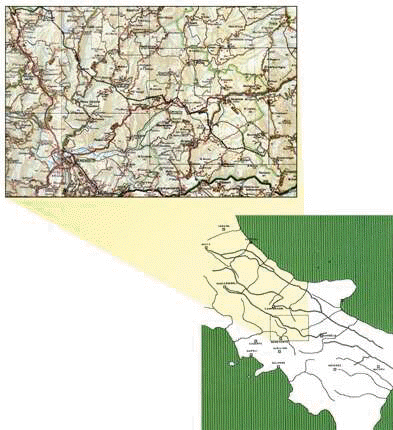
In fact the VII Ks national congress will take place from the 5th
to the 10th September 2006 in Casalbore, a lovely town in
the green Alta Irpinia. For this occasion, we also organized excursions
aimed to visit the roman and longobard
vestiges that were recently restored with passion by the local
archaeologists and excursions aimed to discover the ancient flavours of
our region and of our sound rural tradition. There will be also folk
entertainments with folk singing groups dressed with period costumes.
The hotel accomodation will also have a particular charm, guests will be
accommodated in cool country houses or in ancient monasteries, supplied
with all comforts.
We also scheduled a lot of entertainments for companions, such as golf
lessons, typical cooking lessons or pillow lace lessons, guided
tours to ancient wine cellars, or to stones craftsmen studios.
The programme of the congress of this year proposes a great novelty, it is
an occasion to meet doctors who are already using our method, foreign
delegations have been invited and will contribute with their own
scientific experiences, but the congress will be also a real training
course for new participants, such as doctors, physiotherapists and
podologists, who would like to approach our method. During the congress we
will analyse the clinical problems will concern not only the locomotor
apparatus, but the whole dysfunctional pathologies affecting different
organs and apparatuses, by focusing also on the patient's compliance and
on
psycho-behavioural
involvement of the patient.
So as you can notice there are a lot of reasons to participate to the
congress, last, but not least the educational credits of the ongoing
education in medicine!
So finally I'd like to thank you and to wish you HAPPY HOLIDAYS!
See you in September. |
|
Maria Antonietta Fusco |
|
|
|
 |
KS Italia S.a.s.
is arranging the 7th Ks national
Congress about “Study
days on the balance of postural deficit by a neuro-bio-mechanic
approach" on the ancient pathways of the royal cattle track.
The congress promises to be really intresting both for
the chosen topics, a lot of foreign doctors who adopted the "Doctor
Fusco's method" will contribute to the debate with their own experiences,
and for the beauty and the peculiarities of the territory that we are
going to visit during the congress.
This is the first announcement about this happening, but due to the
obvious organization's difficulties not more than 100 people, besides the
rapporteurs, can attend to the congress. |
 Programme
and information Programme
and information |
|
|
|
|
Info |
|
KS Italia sas Viale
S.Francesco, 32A 83100 Avellino ITALY
Tel. 0825.781515 Fax 0825.786238
E-mail: info@ksitalia.it
|
|
The
transhumance is the a seasonal movement of livestock,
above all sheeps, from the valley pastures to the higher pastures in
order to take advantages from the seasonal changes.
It was a long route moving from the Abruzzo
mountains troughout the valley down to the seaside: the italian poet
Garbiele D'annunzio, in his poem "September" describes it in a very
fascinating way.
The flocks migrations, in the south and insular
Italy moved along grass pathways called
"tratturi" in Abruzzo and Apulia and "trazzere" in Sicily. |
|
IIn
Abruzzo, above all, the transhumance allowed to exploit the large
pasture areas of this region, that for one third of the year are
very grassy and then are covered by the snow, and the large pastures
of the Apulia's lowland, that is rich in grass during the winter and
become then arid during the summer. In this
way it was possible for the shepherds to exploit the richest
pastures all the year long and breed a greater amount of cattle than
the one breedable by remaining in their own region.
During transhumance the shepherds had very frequent
stops for a rest along the way, and
the characteristic and very widespread little churches
were considered as "structures for service"
which could offer, spiritual and physical assistance and comfort,
then the shepherds left for the richest
pastures where they stayed for a longer time and built shelters of
loose stones: the so called pajiare that are like the trulli of
Apulia.
Still nowadays, on the Maiella, there are more or
less thousand pajiare which are often found in groups circled by
walls, which are also built of loose stones,
the high walls give these buildings a fort-like appearance.
And then, from there the shepherds moved down to the
seaside … “I nostri
pastori lascian gli stazzi e vanno verso il mare …” (Gabriele
D’Annunzio). |
|
|

