|
| POSTUROLOGY
: INVESTIGATION'S METHOD |
|
| M.
A. Fusco |
 |
|
The
clinical signs of pathologic manifestations have always been
studied and regarded as very important both by the medicine as
art than by the scientific
medicine. Certainly, every doctor studied SEMEIOTICS at university.
But
what
is the Semeiotics?
|
| “Semeiotics or
Semeiology is the doctrine that teaches how to discover and
understand the meaning of the signs of the diseases.” (G.Viola) |
|
|
Since,
for definition, a sign is the evidence of something
existing or indicates something existing, in medicine,
the science that studies the signs of the diseases,
focuses on those observable manifestations, that can
indicate the presence of a specific pathology or of an
altered physiologic condition.
In
semeiology many authors identify two main pathologic
phenomena: the symptoms, that is the subjective evidence
of the pathology observed by the patient; and the signs,
that is, the alterations or disorders that can be
objective observed and interpreted.
So Semeiotics is strictly linked
to diagnostics. Semeiotics deals not only with the
description of the pathology, but it also involves the
investigation's method and studies the mechanisms that
trigger the symptom and give rise to the disease.
An other important basis of the
medicine is the METHODOLOGY.
|
 |
|
|
Medical methodology is
the discipline that analyzes the general principles, procedure's
rules and logic interferences that should guide the biomedical
research and the clinical praxis.
Medicine has been recently
considered as a scientific discipline. Indeed, only in 1865 the
French physiologist Claude Bernard published “ Introduction to
the study of experimental medicine". This work represents,
still nowadays, the most important treatment of medical
methodology and furthermore it is a fundamental work for the general
methodology of the science. |
| “ Experimental science is a possession
of knowledge characterized by two important elements: the object
of the study and the method employed to study it. Its object is
the natural sensible reality, a reality that can be
empirically proved. The scientific and experimental method is
the element characterizing empiric sciences and consists of
four phases: |
-
observation and classification of a
natural object or of an event,
-
elaboration of an hypothesis or of a
set of hypotheses by supposition,
-
deducing a set of observable
consequences from the elaborated hypothesis,
-
spontaneous or caused observation of
these consequences“ (C. Bernard).
|
|
Furthermore, clinical methodology is aimed
to identify and classify the disease, through the diagnostic
method, and it is aimed to explain the observable symptoms
and to implement an effective therapy.
The clinical investigation consists of three main phases: |
- observation (anamnesis, objective examination,
instrumental data),
- preliminary understanding of the meaning of the symptoms,
- final understanding of the meaning of the diagnostic
results.
|
|
The last phase of the clinical examination
consists of the therapy and of the checking of the therapeutic
results.
Methodologically, this is a further experimental
check out of the elaborated hypotheses.
Applying the principles
of the clinical semeiotics to the observation of the postural
attitude of the patient, I could notice that it is possible to
relate alterations of the spatial arrangement of the body or of
some parts of it (these are the signs), to the symptoms reported
by the patients and to the definitions of pathologies, that
concern only the merely description of the event.
Chronic low
back pain is not a diagnosis, it is only the definition of an
ongoing symptom.
The remark is the
same if we refer to back pains.
However there a lot of studies concerning this topics.
These studies are both statistic studies and studies aimed to
evaluate and compare the results of different therapeutic
approaches. But have you ever thought about the etiology of back
pains? of low back pains? and so on? |
|
|
It is
quite strange to notice that if one side they support
the use of a strictly scientific method, on the other
side they don't pay attention to a fundamental question,
that should be considered as the basis of our work and
of our studies.
When a
patient presents a hyper pyrexia, although arising from
clear symptoms, that can be related to the localization
of the pathology, such as strangury, a careful therapist
before prescribing any medicaments, should first of all
prescribe an analysis of urine with a anti bio-gram. In
this way it is possible to carry out an etiologic
diagnosis. In this way it is also possible to identify the
germ, that caused the infection and choose which
antibiotic is the most suitable to treat the disease.
Only if we follow carefully these diagnostic phases, we
can be sure to prescribe to the patient the best
therapy. After recording the symptoms reported by the
patient, that is strangury, and after observing the
sings of the disease, that is fever and positive mono or
bilateral maneuver of Giordano
|
 |
|
| and after checking the
results of the analysis of urine and anti bio-gram, we make a
diagnosis of "bacterial nephritis caused by......",
specifying in this way the vague definition of "strangury
with hyper pyrexia", that is always a vague definition even
if we enrich it with some other adjectives such as acute,
chronic or recurrent etc........ |
|
Why we don't act in the same way while
facing musculo-skeletal disorders?
The systematic study of the posture of our
patient could reveal signs and clinical manifestations of
musculo-skeletal disorders providing us with the means to
understand the development of these pathologies. It doesn't mean
that we are denying our scientific education and our scientific
tradition, but it means that we are learning how to discover and
understand those signs, that till nowadays were regarded as
"attitudes" having no diagnostic value and no hope to
be treated.
I mean those disorders and musculo-skeletal
symptoms affecting the 78% of western population!!!
I strongly support the use of semeiotic principles
combined with an orthodox scientific method to approach and
treat postural disorders.
|
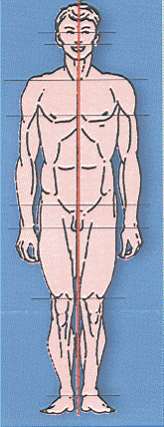
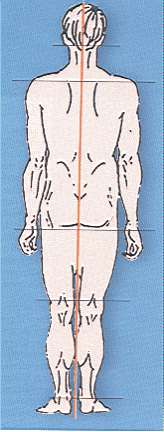
| The observation of the posture of
our patient provides us with information about the symmetric or
asymmetric distribution of the muscular tone or of the fascial
fibro-elasticity. These are phenomena that can be observed and analyzed.
The question is how to observe and analyze them. It is very important
to compare the information about the observed posture with an
ideal normal posture, in order to notice some alterations occurring
in the patients. We therefore established to compare the spatial
arrangement of the examined body with a straight line
perpendicular to the plantar stance, the so called vertical line
of Barrè. In frontal-anterior view, the vertical line of
Barrè should pass through the middle point between the
heels, the pubic symphysis, the alba line and the umbilicus, the
center of the sternum, the center of the neck, the recess of the
chin, the center of the face and of the front and it should
divide the body in two perfectly symmetric parts. In
frontal-posterior view the vertical line of Barrè starting
from the middle point between the heels should pass midway between
the buttocks and the spinous processes of the vertebrae and
should divide the torso, the neck and the head in two perfectly
symmetric parts. The frontal observation of patients, both on
the anterior and on the posterior view, should be focused
also on the ideal horizontal lines, that under perfectly normal
conditions, should lie on parallel planes. Upwards these lines
are:
bi-malleolus line, upper bi-patellar line, bi-ischium line, bi-styloid
line, bi-mammillary line, bi-acromion line, bi-tracheal
line, bi-pupillary line; in the posterior frontal view,
upwards the lines are: bi-malleoulus line, bi-popliteal line,
bi-styloid line, bi-acromion and bi-tracheal line.
|
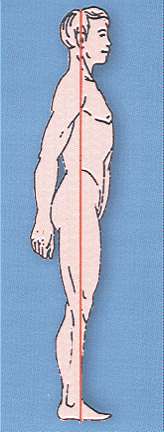
| Observing the patients from a
lateral view, you have also to check out the lateral
anterior left and right view. From this view, the
vertical line of Barrè passes immediately in front of the
lateral malleolus and should pass through the middle of the
knee's joint, through the coxo-femoral joint, immediately in front
of the shoulder joint and through the tragus of the ear. The alignment
should be the same both in the anterior LL right view and
in the anterior LL left view. From the LL view it is important
to observe the attitude of the upper limb and the profile of the
curves of the vertebral column and the profile of the
sacrum. Usually the arm should be aligned to the forearm
with stretched elbow and the palm of the hand turned towards the
trochanter, in this way it would be possible to notice the
physiologic inclination of the sacrum, the lumbar lordosis, the
dorsal kyphosis and the cervical lordosis. |
|
| So the above mentioned method is a
real scientific method of clinical observation. |
|
|
If you compare the posture of
your patients with the ideal standard, you will be able
to "see" signs connected with the regarding
symptoms, so you will identify a connection, that before
you couldn't discover.
For instance, a reduction till a
plain disappearing (verticalization) of the
physiological lumbar lordosis, is always accompanied by
lumbar pains and by sciatic pains; furthermore a
reduction till a plain disappearing (verticalization) of
the physiological cervical lordosis, is always accompanied
by cervical pains and oft by arm pains, muscolo-tensive,
headaches, unstable balance's feeling, photophobia.
If we begin our observation focusing on the signs of
altered spatial arrangement of the vertebral segments or
of the whole vertebral column linked to the signs of
altered spatial arrangement of the shoulder's and pelvic
girdles, we really carry out a postural analysis.
Furthermore, if we compare the altered spatial arrangement
of the bony segments or of the whole organism with the
receptive information coming from the primary esoceptors,
we gather information about new therapeutic
possibilities, that were unknown till nowadays.
|
 |
|
|
|
